
You pull onto your driveway after a heavy downpour.
Instead of disappearing, the rainwater sits in large puddles.
Hours later, it’s still there.
Sound familiar?
Many homeowners assume this is simply part of living in the UK, but it often points to a driveway that isn’t allowing water to drain naturally.
As rainfall becomes heavier and more frequent, traditional impermeable driveways can struggle to cope. That’s one reason why permeable driveways have become increasingly popular across Chester and Cheshire.
They’re not just attractive.
They’re designed to manage rainwater more effectively.
💧 What Is a Permeable Driveway?
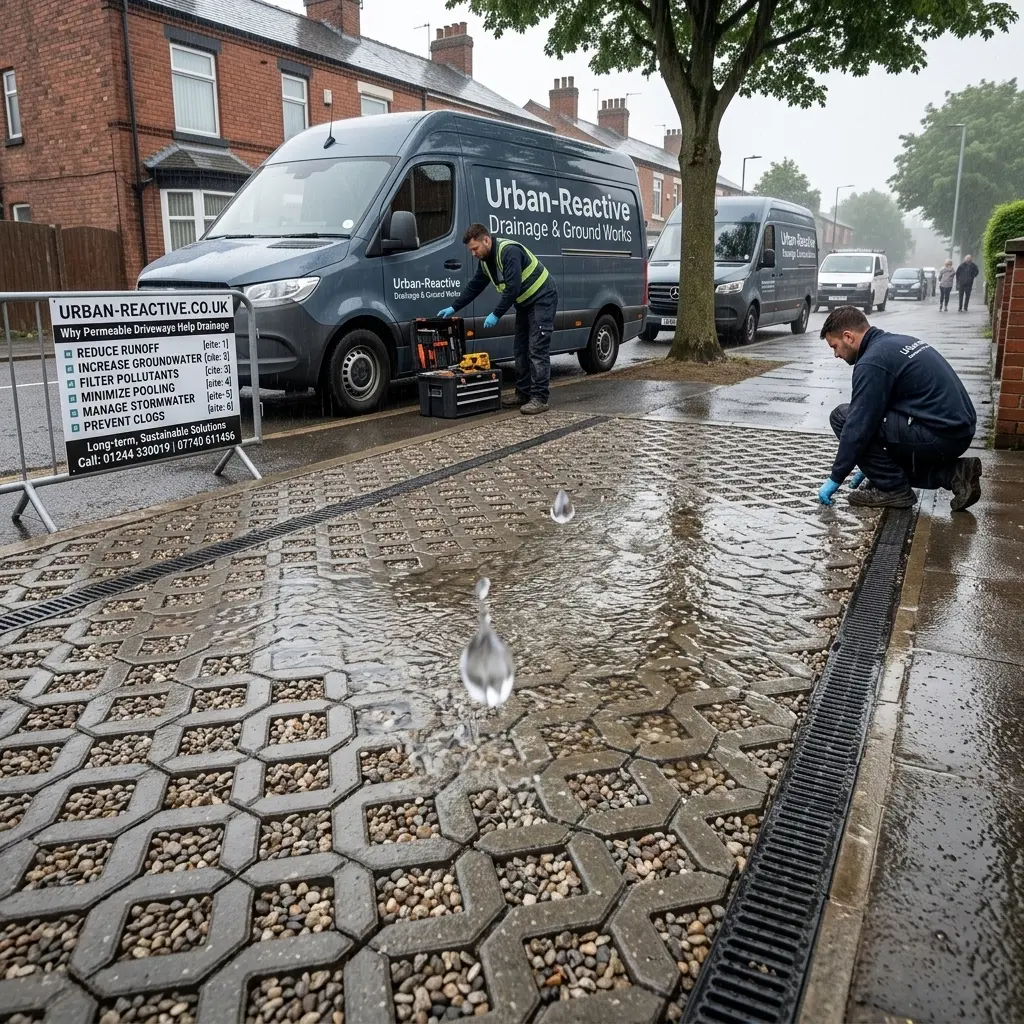
Unlike traditional concrete or solid tarmac surfaces, a permeable driveway is designed to let rainwater pass through the surface and into specially prepared layers beneath.
Instead of rushing towards the nearest drain or road gully, the water filters naturally into the ground.
Common permeable driveway systems include:
- Permeable block paving
- Resin-bound stone (when installed on a permeable base)
- Permeable gravel systems
- Reinforced gravel grids
The hidden groundwork is just as important as the surface itself.
🌧️ Why Surface Water Is Becoming a Bigger Problem
Across Chester, we’ve seen an increase in sudden heavy downpours.
When large amounts of rain fall onto solid driveways, the water has only a few options:
- Flow towards the road
- Enter surface water drains
- Collect in low spots
- Run towards the property
If the drainage system becomes overwhelmed, standing water can develop surprisingly quickly.
A permeable driveway helps reduce that pressure by allowing water to soak into the ground instead.
Heavy Rain
      │
      ▼
Permeable Surface
      │
      ▼
Stone Sub-base
      │
      ▼
Water Slowly Filters
      │
      ▼
Natural Ground
🏡 A Typical Chester Example
Imagine a property in Upton where the driveway regularly flooded after heavy rain.
The paving itself wasn’t damaged.
The problem was that years earlier, a solid surface had been laid over an existing garden area without improving the drainage underneath.
Every storm created the same result.
Water pooled against the garage before eventually overflowing onto the pavement.
When the driveway was rebuilt using a permeable construction with a properly designed sub-base, the difference was immediately noticeable.
The surface remained usable far more quickly after rainfall.
📊 Traditional Driveway vs Permeable Driveway
| Traditional Surface | Permeable Surface |
|---|---|
| Water runs across the surface | Water filters through the surface |
| Greater pressure on drains | Reduces pressure on drainage |
| Standing water more likely | Less surface pooling |
| Can contribute to local flooding | Helps manage rainfall naturally |
| Often relies entirely on gullies | Works with the ground beneath |
Neither system is automatically right for every property, but understanding the difference helps when planning a new driveway.
🚨 Signs Your Existing Driveway May Have Drainage Problems
Take a walk outside after the next spell of heavy rain.
Property Health Check
□ Water remains on the driveway for several hours
□ Puddles regularly appear in the same places
□ Water flows towards the house
□ Moss or algae develops quickly
□ Block paving has started sinking
□ Drainage channels frequently overflow
□ Water runs directly onto the pavement
If several of these apply, the issue may be the driveway’s drainage rather than the surface material itself.
🏗️ The Hidden Secret Is the Groundworks
Many people focus on the paving blocks or resin finish.
In reality, the most important part of a permeable driveway is the construction underneath.
A typical build-up includes:
Driveway Surface
       │
       ▼
Bedding Layer
       │
       ▼
Open-Graded Stone Sub-base
       │
       ▼
Prepared Ground
       │
       ▼
Natural Soil
Each layer plays a role in storing and slowly releasing rainwater.
Without proper groundwork, even the best paving materials won’t perform as intended.
Professional Groundworks in Chester
https://urban-reactive.co.uk/groundworks-in-chester/
Form the foundation of any successful driveway installation.
🌿 More Than Just Better Drainage
A well-designed permeable driveway can offer several practical benefits.
Depending on the property, these may include:
- Reduced standing water
- Less pressure on surface water drainage
- Lower risk of puddles during heavy rain
- Improved appearance after storms
- Better long-term performance of the driveway
For many homeowners, it’s an investment in both practicality and kerb appeal.
🌦️ Is Every Driveway Suitable?
Not always.
Before recommending a permeable driveway, factors such as:
- Ground conditions
- Soil type
- Existing drainage
- Property levels
- Available space
- Local drainage requirements
should all be considered.
Clay-rich soils, for example, may require additional drainage measures beneath the surface to achieve the best results.
Every property is different.

One of the biggest mistakes I see is homeowners concentrating on the finish rather than the foundation.
A beautiful driveway that’s built over poor drainage can soon develop puddles, movement and expensive maintenance issues.
When planning a new driveway, think about where the rainwater is going.
Getting that right from the start often saves a lot of money in the years ahead.
If you need any advice, please do not hesitate to give me, Luke, a call for free, no-obligation advice on 01244 330019.
🔗 Related Guides Worth Reading
Permeable Driveways: Save £££s on UK Flood Damage Repairs!
https://urban-reactive.co.uk/permeable-driveways-save-s-on-uk-flood-damage-repairs/
Garden Drainage Chester Flooding
https://urban-reactive.co.uk/garden-drainage-chester-flooding/
Why Patio Base Preparation Matters
https://urban-reactive.co.uk/patio-base-preparation-chester/
Why Groundworks Are the Foundation of Good Landscaping
https://urban-reactive.co.uk/groundwork-cobblestone-driveway-patio-chester/
Why Driveways Sink in Elton After Wet Weather
https://urban-reactive.co.uk/driveways-sinking-elton-wet-weather/
