
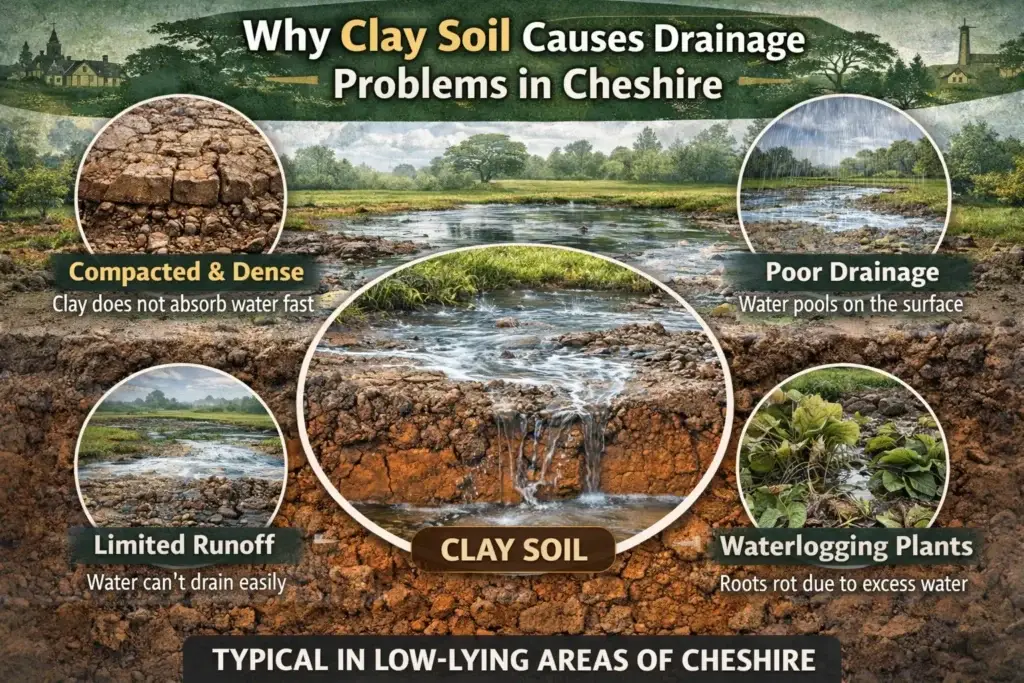
If you’ve ever wondered why gardens in Cheshire seem to stay wet long after the rain stops, the answer is usually sitting right under your feet. Much of the ground around Chester, Hoole, Upton, Tarvin, Mickle Trafford and Christleton is heavy clay. It holds water like a sponge that never quite dries out.
I see it regularly when working on groundworks and drainage jobs in Chester. A homeowner will say their lawn turns boggy every winter or their patio constantly has puddles. Nine times out of ten, the problem isn’t the paving or the drains themselves. It’s the soil underneath struggling to move water away.
Clay soil is made of very fine particles packed tightly together. Because the particles are so dense, water drains through them very slowly. After heavy rain, the ground becomes saturated, and that excess water starts looking for somewhere else to go.
That’s when you start seeing problems around the property.
🔎 Common Signs Clay Soil Is Affecting Your Drainage
Around homes in Cheshire, clay soil can cause a few familiar issues:
• Lawns that stay soggy for days after rain
• Puddles forming on patios and driveways
• Water sitting around the inspection chambers
• Slow-draining gullies and surface drains
• Gardens that feel soft or muddy underfoot
In some cases, the extra water can even contribute to blocked or overloaded surface drainage systems. That’s when we start checking the wider system, including bold keywords and backlink examples: Drainage in Chester or Blocked Drains Chester.
🛠️ How We Usually Fix Clay Drainage Problems
The key is helping water move away from the area rather than trying to fight the soil itself.
Solutions often include:
• Installing French drains to redirect water
• Improving surface drainage channels
• Adding soakaway systems where space allows
• Rebuilding patio or driveway bases with proper drainage layers
Sometimes we also carry out a CCTV Drain Survey in Chester just to make sure there isn’t an underlying pipe issue making things worse.


If your garden constantly stays wet in winter, don’t assume the drains are blocked straight away. In Cheshire, it’s very often the clay soil that slows everything down. The trick is designing drainage that works with the ground conditions rather than against them.
I’m Luke from Urban-Reactive.co.uk. If you’re unsure what you’re looking at or just want a bit of free, honest advice before calling anyone out, give me a shout — I’m always happy to point you in the right direction.

Have you seen
https://urban-reactive.co.uk/patio-base-preparation-chester/
or https://urban-reactive.co.uk/patch-liner-drain-repair-chester/
Or https://urban-reactive.co.uk/garden-drainage-planning-chester/