
The best time to discover your garden drainage isn’t coping is not when water is already heading towards the back door.
Garden flooding often looks sudden. In reality, the warning signs may have been sitting there for weeks: a lawn that stays soggy, a gully that drains slowly, a patio puddle that gets slightly longer every time it rains.
Across Chester, Hoole, Upton, Blacon, Boughton, Saltney and Vicars Cross, getting ahead of those warning signs before prolonged or heavy rain can make a considerable difference.
So, rather than waiting for the next downpour, here’s a practical pre-rain property check you can carry out while the garden is still dry.
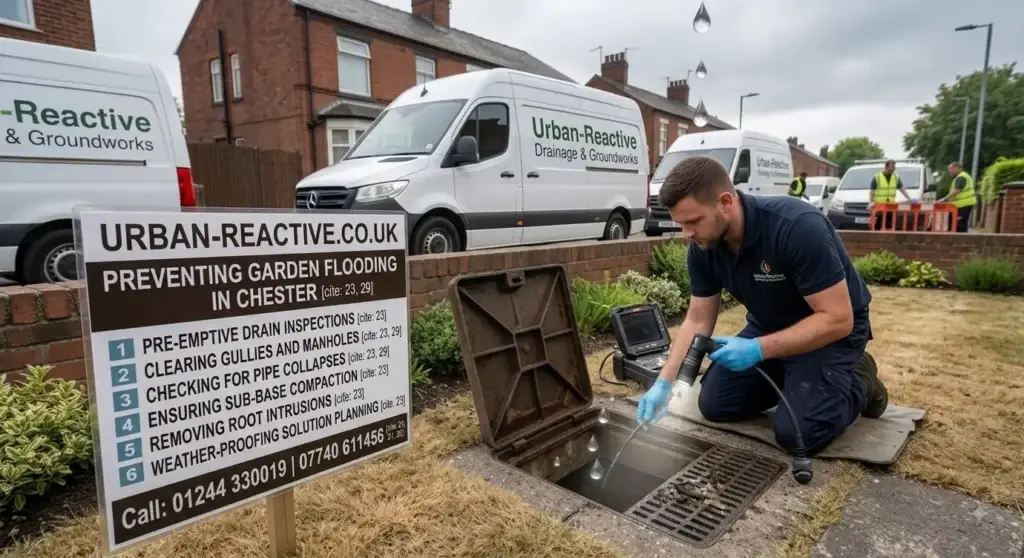
⏱️ The 10-Minute Garden Flood Check
Walk around your property and look at these five areas.
1. Start at the Outside Gullies
Look through every accessible gully grate.
Can you see:
- Leaves?
- Moss?
- Soil?
- Grass cuttings?
- Silt?
- Standing water?
A small amount of debris may not appear serious on a dry day.
Add a sudden downpour and that partially restricted gully may become the point where water starts backing up.
Quick job: Remove accessible surface debris before rain arrives.
2. Look at Where Your Patio Sends the Water
Here’s a simple test.
Stand at the highest part of your patio and imagine tipping a bucket of water onto it.
Where would that water travel?
GOOD FALL

HOUSE
  │
  │   Patio
  └───────────────↘
                   ↘ Drainage


POTENTIAL PROBLEM

HOUSE
  │   ← Water
  │  ←
  └─────────────── Patio
Surface water should be managed so it doesn’t simply collect against the building.
If puddles regularly form beside doors, walls or extensions, don’t assume that’s normal.
🌱 3. Read What Your Lawn Is Telling You
Your lawn can be a surprisingly useful indicator of drainage.
Look for:
🟢 Healthy and reasonably firm
Usually nothing obvious to worry about.
🟠 Soft patches long after previous rainfall
Worth monitoring.
🔴 Persistent standing water or boggy ground
Drainage investigation may be worthwhile.
Repeated waterlogging can have several causes, including compacted soil, clay-rich ground, inadequate surface drainage or a soakaway that’s no longer coping effectively.
Cheshire’s clay-rich soils can make surface-water management particularly challenging because water may infiltrate slowly.
🕳️ 4. Don’t Forget the Soakaway
A soakaway isn’t something most homeowners think about until the garden stops draining properly.
Its job is to receive surface water and allow it to disperse gradually into suitable surrounding ground.
Problems can develop if the system:
- Has become silted
- Is undersized
- Has deteriorated
- Is surrounded by poorly draining ground
- Receives more water than it was designed to manage
One useful clue is how quickly standing water disappears after ordinary rainfall.
If the same part of your garden remains waterlogged considerably longer than it used to, something may have changed.
🚨 5. Check the Warning Signs Before the Storm
Give yourself one point for each statement that applies:
- My lawn regularly stays wet after rain.
- Water collects beside the house.
- One or more outside gullies drain slowly.
- My drainage channels contain leaves or silt.
- The patio has obvious low spots.
- A driveway drain has overflowed before.
- I’ve had garden flooding previously.
- The same outside drain repeatedly blocks.
Your Result
0–1 points:
Keep up routine maintenance and monitor things during heavy rain.
2–3 points:
There are enough warning signs to justify checking where surface water is going.
4+ points:
Don’t wait for the next major downpour to discover whether the system can cope. A proper drainage assessment could identify the cause before flooding occurs.
This isn’t a technical diagnosis, just a useful homeowner screening check.
🌧️ Why a Sudden Downpour Exposes Hidden Problems
A garden might cope perfectly well with light rain.
The real test comes when a large volume of water arrives quickly.
Think of the system like a funnel:
              HEAVY RAIN
          ↓ ↓ ↓ ↓ ↓ ↓ ↓
        \             /
         \           /
          \         /
           \       /
            \     /
             \   /
              \ /
               ↓
          DRAINAGE SYSTEM
               ↓
         Can it cope?
If gullies are partially blocked, the ground is already saturated, or a soakaway is struggling, water can arrive faster than the system can remove it.
That’s when a minor drainage weakness becomes a flooded patio or waterlogged lawn.
Urban Reactive’s published guidance also highlights standing water, slow gullies and repeated minor blockages as warning signs that can precede more serious drainage problems.
🏡 What Can You Do Before Heavy Rain?
Some preventative jobs are surprisingly simple.
TODAY
✔ Clear accessible leaves and debris.
✔ Check drainage channel grates.
✔ Look for standing water in gullies.
✔ Remove garden waste covering drainage points.
BEFORE THE NEXT HEAVY DOWNPOUR
✔ Watch where water naturally travels across patios and driveways.
✔ Check areas that remained wet after previous rainfall.
✔ Make sure you know where your surface-water drainage discharges.
IF THE SAME PROBLEM KEEPS RETURNING
That’s when I’d stop treating it as a weather problem.
Recurring flooding may require investigation into the drainage layout, soakaway performance, ground conditions or underground pipework.
⚠️ The Mistake: Waiting Until the Garden Floods
Once heavy rain arrives, you’re reacting to the problem.
Beforehand, you have an opportunity to prevent it.
The difference might be as simple as clearing a restricted gully.
Or an investigation might reveal something more substantial, such as:
- Poor garden levels
- Inadequate drainage
- Failed soakaway
- Damaged underground drainage
- Root intrusion
- Unsuitable surface-water arrangements
You won’t know which until the cause is identified.
✍️ Luke’s Advice: Take Photos When It Rains
Here’s one simple tip that can make diagnosing garden flooding much easier.
Take photographs or a short video during the next heavy downpour.
Show:
- Where the water first appears
- Which direction it’s travelling
- Which gullies overflow
- Where the deepest puddles develop
- How close the water gets to the property
By the time somebody investigates on a dry day, most of that evidence has disappeared.
A 30-second video of the garden during heavy rain can tell us a surprising amount about what’s actually happening.
🔗 Related Guides Worth Reading
Why Garden Drainage Problems Occur in Mickle Trafford
https://urban-reactive.co.uk/garden-drainage-problems-mickle-trafford/
Why Clay Soil Causes Drainage Problems in Cheshire
https://urban-reactive.co.uk/clay-soil-drainage-problems-cheshire/
Signs Your Property Needs a New Soakaway
https://urban-reactive.co.uk/signs-new-soakaway-chester/
Why Drain Maintenance Prevents Expensive Repairs
https://urban-reactive.co.uk/drain-maintenance-prevents-repairs-chester/
Storm Drain Problems in Chester
https://urban-reactive.co.uk/storm-drain-problems-chester/
